


Indy 500
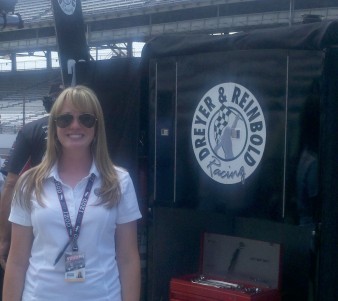
The last week has brought more madness, but when it comes to the Indy 500, madness is expected and welcomed!
I have learned just how vital sponsors are to the IndyCar operation and how all teams wouldn’t be who they are without the loyal dedication of their sponsors. Much of my time has been spent giving these people tours of the garage and pits, which I absolutely enjoy. Here are some fun facts that I have learned along the way pertaining to the race and IndyCars:
- Each car gets 33 sets of tires for the Indy 500
- Each set costs around $2,500
- Once we get the tires from Firestone, the teams take out the air and fill them with nitrogen…the air expands and wears the tires too quickly.
- A finished IndyCar weighs around 1,500 pounds and is made out of carbon fiber.
- Once the drivers are in the car, they try to make them all weigh as close to one another…Danica Patrick or Ana Beatriz, for example would have to add weight to their car to be more similar to taller drivers such as Justin Wilson who is 6’3”
- A complete IndyCar costs around $500,000
- IndyCar leases all engines from Honda, so they have sole control over when to run them…to lease one engine, it costs $80,000-$100,000
- The seat the driver sits in is customized to their body…in order to do that, the driver sits on a large bean bag filled with resin. They then suck out all of the air so that the bag molds to their shape.
- An IndyCar wheel ends up costing around $15,000…the driver can customize the wheel to show fuel, oil pressure, lap times, etc.
- The drivers have a push-to-pass button on the wheel, which gives them an extra boost for about 20 seconds. The number of push-to-pass they get depends on the length of each track, but they usually get around 20. Once they press the button, there is a reset factor afterwards, so they have to wait a bit before they can press it again. There is also a button on the wheel to radio into the crew members…once the car is in the pits, that radio frequency can only be heard by the crew members and the driver.
- There is enough downforce on an IndyCar that you could turn the car upside down and it would drive on the ceiling.
Hope you all find those facts interesting!
All four of Dreyer and Reinbold’s cars qualified for the race with Davey Hamilton starting 15th, Justin Wilson 20th, Paul Tracy 25th and Ana Beatriz 33rd. I’m looking forward to the upcoming race and can’t wait for the excitement that May 29th will bring!